Key Points
- GS1 Sunrise 2027 targets the end of 2027 for U.S. retail checkout scanners to read 2D barcodes (GS1 DataMatrix/QR), alongside the existing UPC.
- A 2D code can carry GTIN, batch/lot, expiration date and serial number in one symbol — not just a product ID.
- Coding & marking equipment needs higher print resolution and verification-grade quality to produce scannable 2D codes at small sizes.
- Grocery, pharma, cosmetics, apparel and industrial goods are all affected to varying degrees.
What Is GS1 Sunrise 2027?
GS1 Sunrise 2027 is a U.S. retail industry initiative, coordinated by GS1 US in partnership with major retailers, grocers, and consumer brands, aimed at transitioning point-of-sale (POS) scanning from 1D barcodes to 2D barcodes. GS1 is the global standards organization behind the UPC barcode that has anchored retail scanning since the 1970s — the same organization that assigns the GTIN (Global Trade Item Number) printed on virtually every consumer product sold in North America.
"Sunrise 2027" refers to the target date: by the end of 2027, the industry wants retail checkout scanners broadly capable of reading 2D barcodes — specifically the GS1 DataMatrix and GS1 QR Code symbologies — not just the familiar black-and-white UPC bars. Once that infrastructure is in place, brands can begin printing 2D codes on primary packaging that carry far more information than a GTIN alone, without waiting on a hard cutover date that forces the old barcode out overnight.
It's important to understand what Sunrise 2027 is not: it isn't a single law, and it isn't a flash cutover where UPC barcodes suddenly stop working. It's a transition window during which 1D and 2D barcodes coexist on packaging and at checkout, giving brands and retailers time to upgrade scanning hardware, point-of-sale software, and packaging artwork in parallel.
Why Is the Industry Moving to 2D Barcodes?
The 1D UPC barcode has one job: identify what a product is. It cannot tell a scanner which batch that unit came from, when it expires, or which individual unit it is. A GS1 DataMatrix or QR code can encode all of that — GTIN, batch/lot, expiration date, and serial number — as GS1 Application Identifiers (AIs) packed into a single 2D symbol roughly the same size as, or smaller than, today's UPC.
That extra data unlocks several concrete operational benefits that are driving adoption:
- Expiration-date visibility at checkout. A 2D barcode lets a POS system see a product's expiration date automatically, enabling dynamic markdowns on aging stock and preventing expired product from ringing up at all — both a waste-reduction and a compliance win for grocery and food retailers.
- Faster, more precise recalls. With batch/lot and serial data embedded in the barcode, a recall can be scoped to the exact lots affected rather than pulling an entire SKU from shelves nationwide.
- Supply chain traceability. Serialized 2D codes make it possible to trace a unit from manufacturing line to store shelf, which matters increasingly for food safety (FSMA 204 traceability requirements), pharmaceuticals (DSCSA), and brand anti-counterfeiting programs.
- One code, less packaging clutter. Brands currently printing a UPC, a separate date code, and sometimes a QR code for marketing or verification each take up separate space. A single GS1 2D barcode can consolidate that data and reclaim packaging real estate.
- Global alignment. GS1 is an international standard, and 2D barcode transitions are already underway in other markets. Moving early keeps a brand's packaging workflow consistent across regions.
How This Changes the Coding & Marking Industry
For decades, most coding and marking equipment on a packaging line has had one relatively modest job: print a date code, a lot number, and maybe a simple 1D barcode, all in large, low-resolution characters that are easy for older print engines to produce and easy for the human eye to read. Sunrise 2027 raises the technical bar considerably.
From simple date codes to dense, verification-grade symbols
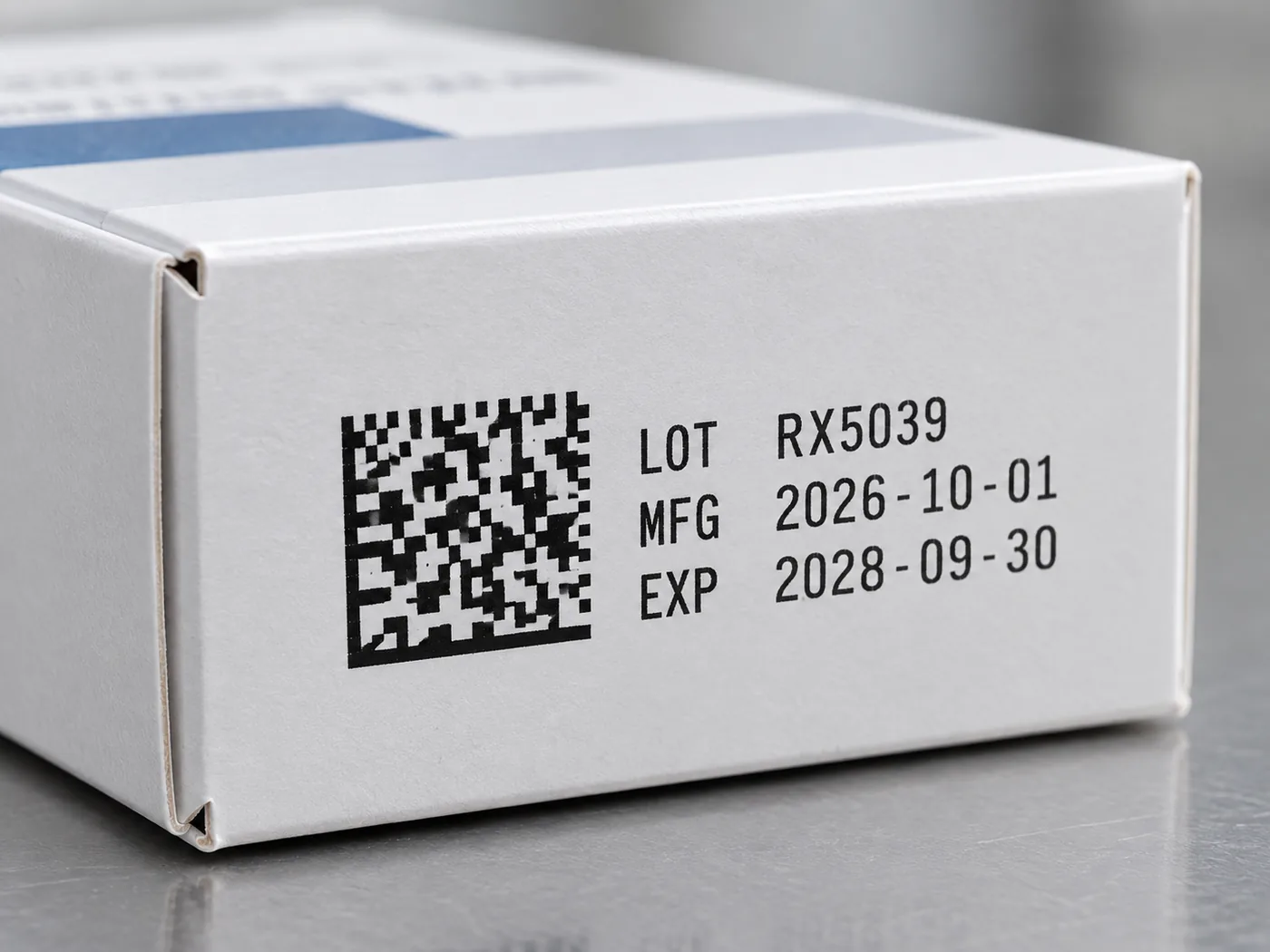
A GS1 DataMatrix encoding a GTIN, batch, expiration date and serial number is a dense grid of small modules. Printing it legibly — and scannably — at the size most packaging allows requires meaningfully higher print resolution than a basic date code. A blurred or low-contrast 1D barcode might still be human-readable; a DataMatrix with the same level of print degradation often won't scan at all.
Print quality verification becomes non-negotiable
Retailers and regulated industries increasingly expect 2D codes to meet a formal quality grade under ISO/IEC 15415 (symbol quality) and, for human-readable text, ISO/IEC 15416. That means manufacturers can no longer eyeball a printed code and assume it's good — they need verification-grade print quality built into the printing process itself, with consistent contrast, edge definition and module placement run after run.
Variable data at full line speed
Every GS1 2D code on a Sunrise-2027-ready package is typically unique or batch-specific — carrying a serial number, lot, and expiration date that changes from unit to unit or batch to batch. That's a variable-data printing job, not a static one, and it has to keep up with real production line speeds without introducing bottlenecks or errors.
Less space, more data
Packaging real estate isn't growing to make room for this. Brands need print technology capable of producing a small, dense, high-fidelity 2D code in the same footprint — or smaller — than the barcode it's replacing.
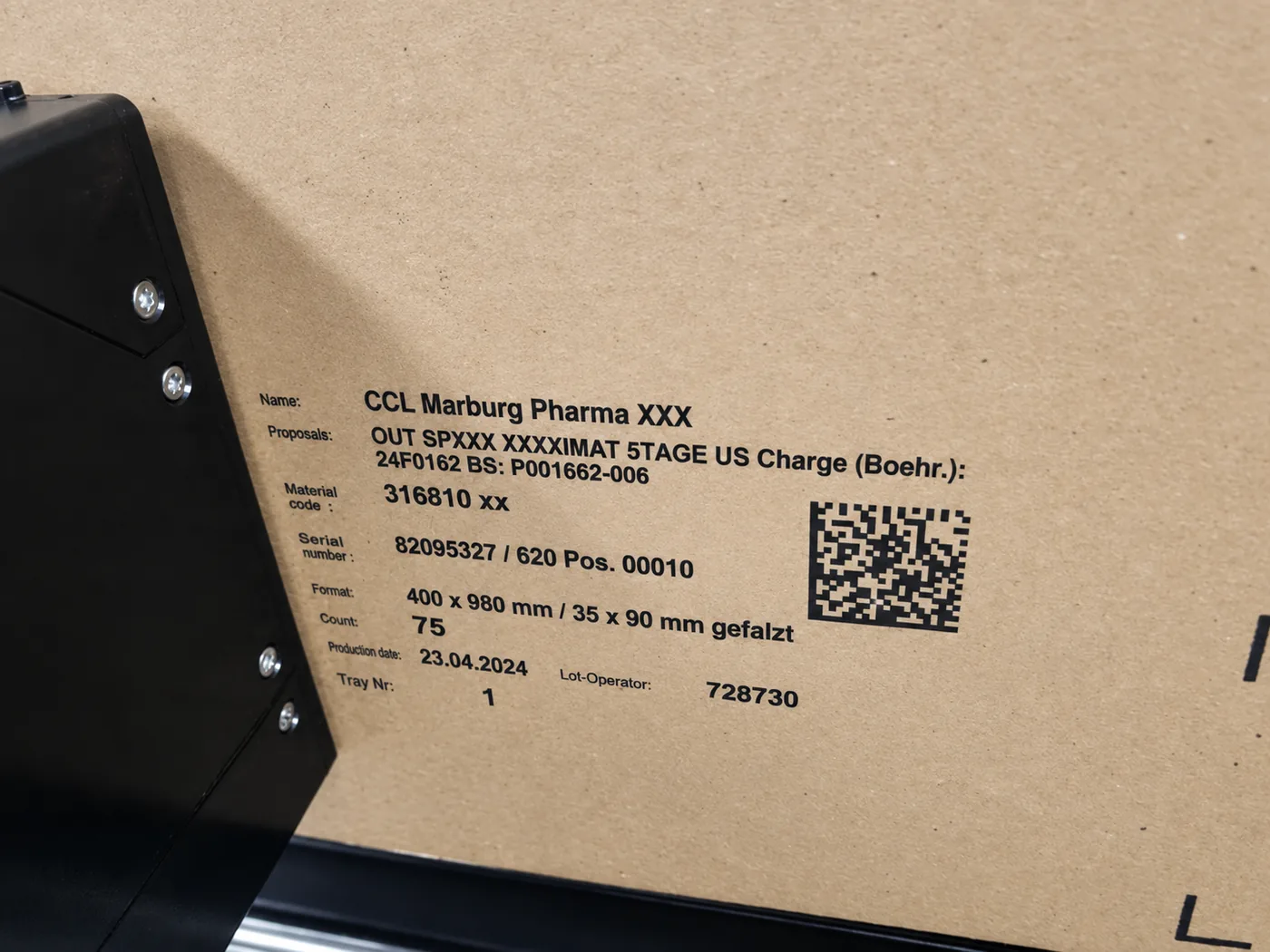
Case- and pallet-level 2D codes paired with human-readable production data, printed with an RNJet large-character piezo printer.
Which Industries Will Be Affected
Because the UPC barcode touches nearly every physical product sold at retail, the 2D barcode transition has a wide footprint. Some industries are affected directly through Sunrise 2027 retail scanning; others are already moving to 2D codes under separate regulatory mandates that point in the same direction.
Grocery, food & beverage, and CPG
This is the primary focus of Sunrise 2027. Expiration-date visibility and dynamic markdowns matter most for perishable and short-shelf-life goods, and food traceability requirements (like FSMA 204 in the U.S.) are pushing lot-level data onto packaging and cases regardless of the retail barcode transition.
Pharmaceuticals & medical devices
Pharma was ahead of the curve here. The U.S. Drug Supply Chain Security Act (DSCSA) already requires serialized 2D barcoding on prescription drug packaging, and the FDA's Unique Device Identification (UDI) rule requires a similar DataMatrix-based identifier on medical devices. Sunrise 2027 aligns retail scanning with standards this sector has largely already adopted.
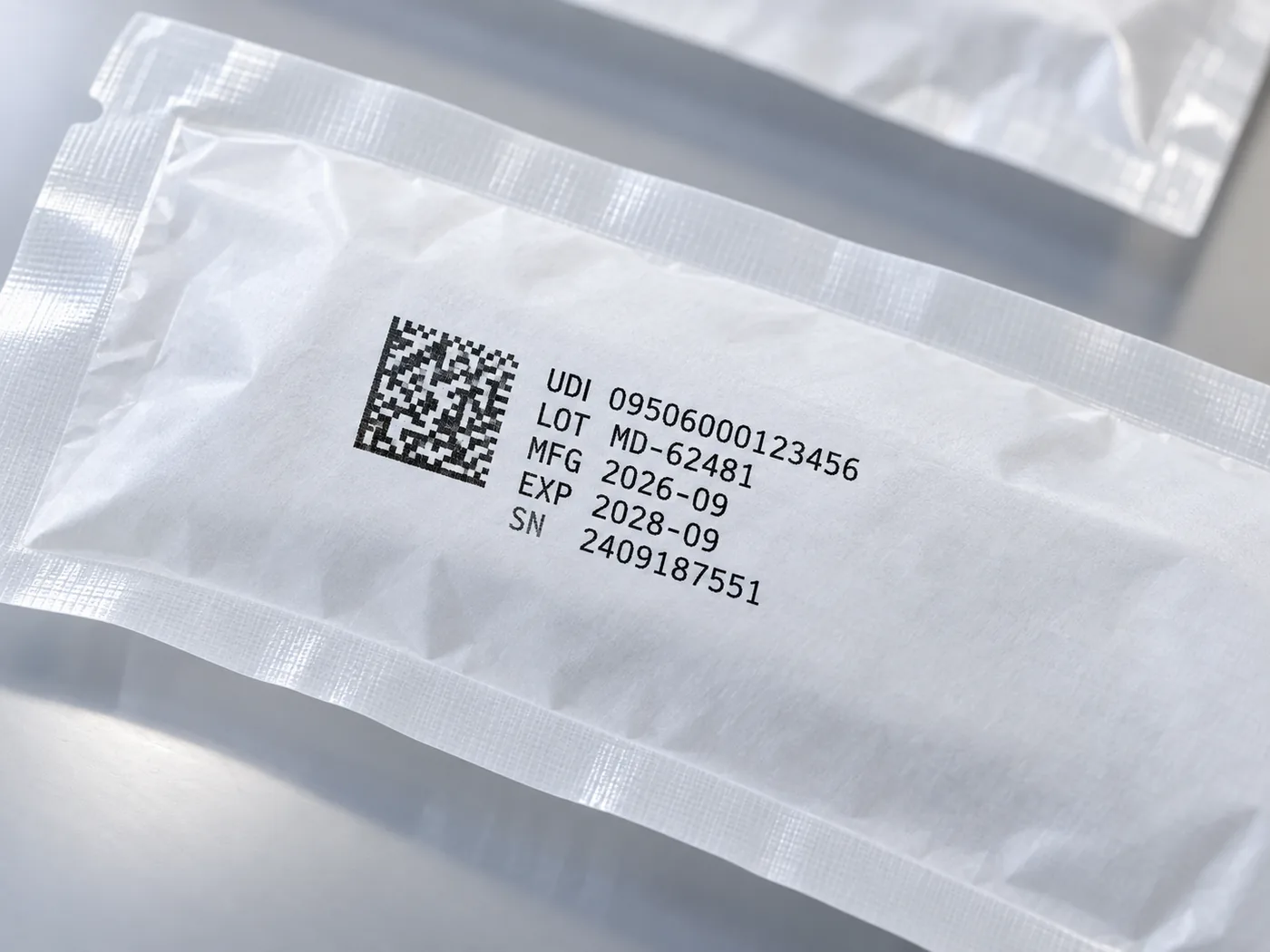
A serialized UDI DataMatrix on a sterile medical pouch — the same print discipline Sunrise 2027 brings to general retail.
Cosmetics & personal care
Many markets outside the U.S. already require batch-code traceability and expiration data on cosmetics. Brands selling internationally are natural early adopters of 2D codes that satisfy both U.S. retail and overseas regulatory requirements in one symbol.
Apparel & general retail merchandise
Less urgency around expiration dates, but still affected — 2D codes support serialized SKUs for loss prevention, returns handling, and omnichannel inventory accuracy (e.g., linking a hang-tag code to size, color and batch for a single return workflow).
Industrial & B2B goods
Even outside retail checkout, manufacturers shipping cases and pallets through distribution are adopting GS1-compliant 2D codes for warehouse scanning, traceability, and compliance with customer-mandated labeling specs (a growing number of large retail and industrial buyers now require GS1-standard case labeling as a condition of doing business).
What Manufacturers Need to Do to Prepare
Sunrise 2027 doesn't require ripping out every system overnight, but waiting until 2027 to start is a mistake — packaging artwork, line integration and equipment qualification all take longer than brands expect. A realistic preparation checklist looks like this:
- Audit your current codes. Identify every SKU and packaging format that currently relies on a 1D barcode or a basic date code, and map out where a 2D GS1 DataMatrix would need to go.
- Check your print resolution. Confirm your coding and marking equipment can print at a resolution (generally 600 DPI or higher for small codes) that produces a 2D symbol meeting ISO/IEC 15415 grade requirements at your packaging's print area.
- Add verification to the line. A barcode verifier at the point of print catches quality problems before cases ship, not after a retailer's receiving dock rejects a pallet.
- Plan for variable data. Make sure your printer's control software can pull batch, lot, expiration and serial data directly from your ERP/MES system rather than requiring manual entry per job.
- Pilot before you scale. Run a 2D code change on one SKU or one line first, verify it scans cleanly end-to-end at a retail partner, then roll the change out across your catalog.
How RNJet Printers Help Manufacturers Get Ahead of Sunrise 2027
RNJet USA's printer lineup is built around exactly the two requirements Sunrise 2027 puts on a production line: high-resolution, verification-capable printing, and the ability to handle variable, serialized data without slowing the line down.
High-resolution thermal inkjet for primary packaging
The RNJet H1, H2, H4 and H24 thermal inkjet (TIJ) printers are designed for exactly the kind of small, dense, high-contrast 2D codes Sunrise 2027 calls for — the same print technology already used to print GS1 DataMatrix and UDI codes on pharmaceutical cartons, medical device pouches, and food packaging today. With a 7″ touchscreen controller and support for variable data fields, an H1 or H4 can print a unique GS1 DataMatrix — GTIN, batch, expiration date and serial number — on every single unit without manual intervention, at the speed your line already runs.
Case- and pallet-level marking with piezo printers
2D codes aren't only needed on primary packaging. Retailer and distributor labeling specs increasingly require GS1-compliant codes on shipping cases and pallets too. RNJet's large-character piezo printers — the RNJet 72, E1-140 and their XL variants — print high-contrast DataMatrix and QR codes directly onto corrugated cases alongside human-readable production data, matching the case-marking example above.
Built for serialized, variable data at line speed
Every RNJet printer in this lineup is designed around variable data printing from day one — sequential serial numbers, batch-specific lot codes, and date fields that update automatically, pulled from simple text/CSV input or integrated with your production database. That's the same underlying capability a GS1-compliant 2D code requires: a different, correct code on every unit, printed without slowing down the line.
No daily maintenance, consistent print quality
Print-quality consistency matters more under Sunrise 2027 than it used to, because a degraded 2D code doesn't just look worse — it fails to scan. RNJet's cartridge-based TIJ printers are built to hold consistent resolution and contrast run after run without the daily cleaning and adjustment older print heads often require, which is exactly the reliability a verification-grade barcode program depends on.
A Practical Roadmap: 5 Steps to Sunrise-2027 Readiness
- Audit. List every SKU and packaging line still relying on 1D-only barcoding.
- Pilot. Choose one SKU, add a GS1 DataMatrix alongside your existing barcode, and verify it against ISO/IEC 15415 grading.
- Equip. Confirm your printer can hit the resolution and variable-data requirements — upgrade where it can't.
- Integrate. Connect your printer's control software to your ERP/MES so batch, lot and serial data flow automatically into every print job.
- Scale. Roll the verified 2D code out across your full catalog ahead of the 2027 deadline, not in the final months before it.
Starting now, rather than waiting for 2027, gives you time to pilot properly, train line staff, and fix packaging artwork issues before they become a retailer compliance problem.
Frequently Asked Questions
What is GS1 Sunrise 2027?
GS1 Sunrise 2027 is a U.S. retail industry initiative, led by GS1 US with major retailers and brands, targeting the end of 2027 for point-of-sale systems to be able to scan 2D barcodes — such as GS1 DataMatrix and QR codes — instead of relying only on the traditional 1D UPC barcode. The goal is to let a single 2D barcode carry richer data, like batch/lot, expiration date, and serial number, alongside the product's GTIN.
Is GS1 Sunrise 2027 mandatory?
There is no single federal law mandating Sunrise 2027. It's an industry-coordinated transition: retailers are upgrading point-of-sale scanning infrastructure to accept 2D barcodes, and brands that adopt early gain operational benefits — expiration-date visibility, faster recalls, serialization — ahead of the rest of the market. In regulated sectors like pharmaceuticals and medical devices, 2D barcoding is already required separately under DSCSA and UDI rules.
Do I need to replace my current coding and marking printer?
Not always, but many printers installed for simple 1D barcodes and date codes don't have the print resolution or verification capability to produce a scannable, grade-passing GS1 DataMatrix at small sizes. Thermal inkjet printers with 600 DPI or higher, like the RNJet H-series, are generally well suited for printing compact 2D codes; older or lower-resolution equipment often needs an upgrade.
What's the difference between a UPC barcode and a GS1 DataMatrix code?
A UPC is a 1D (linear) barcode that typically encodes only a product's GTIN. A GS1 DataMatrix is a 2D barcode that can encode the GTIN plus additional data such as batch/lot number, expiration date, and serial number, all in a smaller physical footprint than a comparable 1D barcode carrying the same data.
Which industries are most affected by the 2D barcode transition?
Grocery, food & beverage, and CPG brands are the primary focus of Sunrise 2027 retail scanning, but pharmaceuticals, medical devices, cosmetics, apparel, and general retail goods are all affected, since nearly every product scanned at a U.S. retail point of sale uses a GS1-governed barcode.
Get Your Line Ready for 2D Barcoding
Whether you need to add a GS1 DataMatrix to primary packaging, mark shipping cases to a retailer's compliance spec, or just want a straight answer on whether your current printer can handle it, RNJet USA's technical team can help you scope the right equipment for your line. Get in touch or call +1 (313) 471-4666 for a free consultation.