Key Points
- Seven states have passed packaging Extended Producer Responsibility (EPR) laws: Maine, Oregon, Colorado, California, Minnesota, Maryland and Washington.
- Fees are based on the weight and material of everything you put on the market — including labels, not just the primary container.
- Hard-to-recycle packaging (large labels, strong adhesives, certain films) can land in a higher "eco-modulated" fee tier.
- Direct inkjet coding replaces a label with a thin layer of ink, cutting reportable material, liner waste and obsolete pre-printed inventory.
For most US manufacturers, packaging has always been a purchasing decision. You chose a carton, a film, a label and a box based on cost, protection and shelf appeal. What happened to it after the customer threw it away was someone else's problem.
That is no longer true.
Seven US states have now passed packaging Extended Producer Responsibility (EPR) laws: Maine, Oregon, Colorado, California, Minnesota, Maryland and Washington. Under these laws, the brand owner that puts packaging on the market pays to recycle or dispose of it. Fees are calculated by weight and material type, and every packaging component counts — including the label on your bottle and the sticker on your carton.
Colorado sent its first producer invoices in January 2026. California's program is scheduled to begin by January 1, 2027. Washington, Maryland and Minnesota follow between 2027 and 2029. For many brands, packaging has quietly become a recurring cost on the P&L.
This article looks at what EPR means on the plant floor, why labels and pre-printed packaging deserve a second look, and how direct inkjet coding can help US manufacturers use less material, waste less and stay flexible.
What Is Packaging EPR?
Extended Producer Responsibility shifts the cost of managing packaging waste from cities and taxpayers to the companies that sell packaged products. In most states, that "producer" is the brand owner. If the brand owner has no US presence, the obligation usually falls to the importer or first distributor.
The core obligations are similar in every state:
- Register with a Producer Responsibility Organization (PRO). Six of the seven states have appointed the Circular Action Alliance.
- Report how much packaging you sold into the state, broken down by material type and weight.
- Pay fees based on that report, which fund collection, recycling and education programs.
Most states also use eco-modulation. In simple terms, packaging that is easy to recycle earns lower fees, and packaging that is hard to recycle pays more. Labels, adhesives, sleeves and inks are among the design features that can affect how recyclable a package is judged to be.
Small producers are often exempt, based on revenue or tonnage thresholds that differ by state. Some packaging, such as many business-to-business shipments and regulated medical packaging, may be excluded. Your compliance team or PRO will confirm exactly what applies to you.
Where the States Stand Right Now
The timelines are uneven, which is part of what makes EPR hard to plan for:
- Colorado: Producers were invoiced for the first time in January 2026, and dues are owed by January 1 each year.
- Oregon: The longest-running program, active since July 2025. A legal challenge by a distributors' association is ongoing, but the law remains in force for most producers.
- California: SB 54 regulations took effect in May 2026, and the program is set to start by January 1, 2027, with aggressive targets for plastic source reduction and recycling.
- Washington: Annual producer fees are scheduled to begin May 1, 2027.
- Maryland: Producers begin paying a share of costs from July 1, 2028.
- Minnesota: Producer funding begins in February 2029, rising to 90% of net program costs by 2031.
- Maine: The first state to pass a law, but its program has been slower to launch.
One more point matters for budgeting. Legal analysts have reported that the PRO has warned producers not to treat early fee schedules as a guide, and that fees are expected to increase significantly. Several states are also tied up in litigation. But the direction is clear: packaging will cost more to put on the market, and the brands that use less of it will pay less.
Why Labels Deserve a Second Look
When most people think about EPR, they think about bottles, trays and boxes. But labels are packaging components too, and they add cost in more ways than one.
Labels add reported material. Every pressure-sensitive label adds face stock and adhesive to each unit. On a single pack it is a few grams. Across millions of units sold into multiple EPR states, it becomes reportable tonnage.
Labels can affect recyclability. Large paper labels, full sleeves and strong adhesives can interfere with sorting and washing at recycling facilities. Under eco-modulated fee systems, that can push a package into a higher fee band.
Labels create waste before the product ever ships. The silicone-coated liner on a label roll is thrown away at your plant. So are misapplied labels, partial rolls and end-of-run leftovers. That is waste you pay for twice: once to buy it and again to dispose of it.
Pre-printed packaging becomes obsolete. If your cartons or cases carry SKU-specific information that is pre-printed by a converter, every product change, regulatory update or rebrand can leave pallets of unusable packaging in the warehouse.
None of this means labels are going away. For some applications they remain the right answer. But EPR gives every manufacturer a strong reason to ask: does this information really need its own label, or could it be printed directly on the package?
Direct Inkjet Coding: Printing the Information, Not the Material
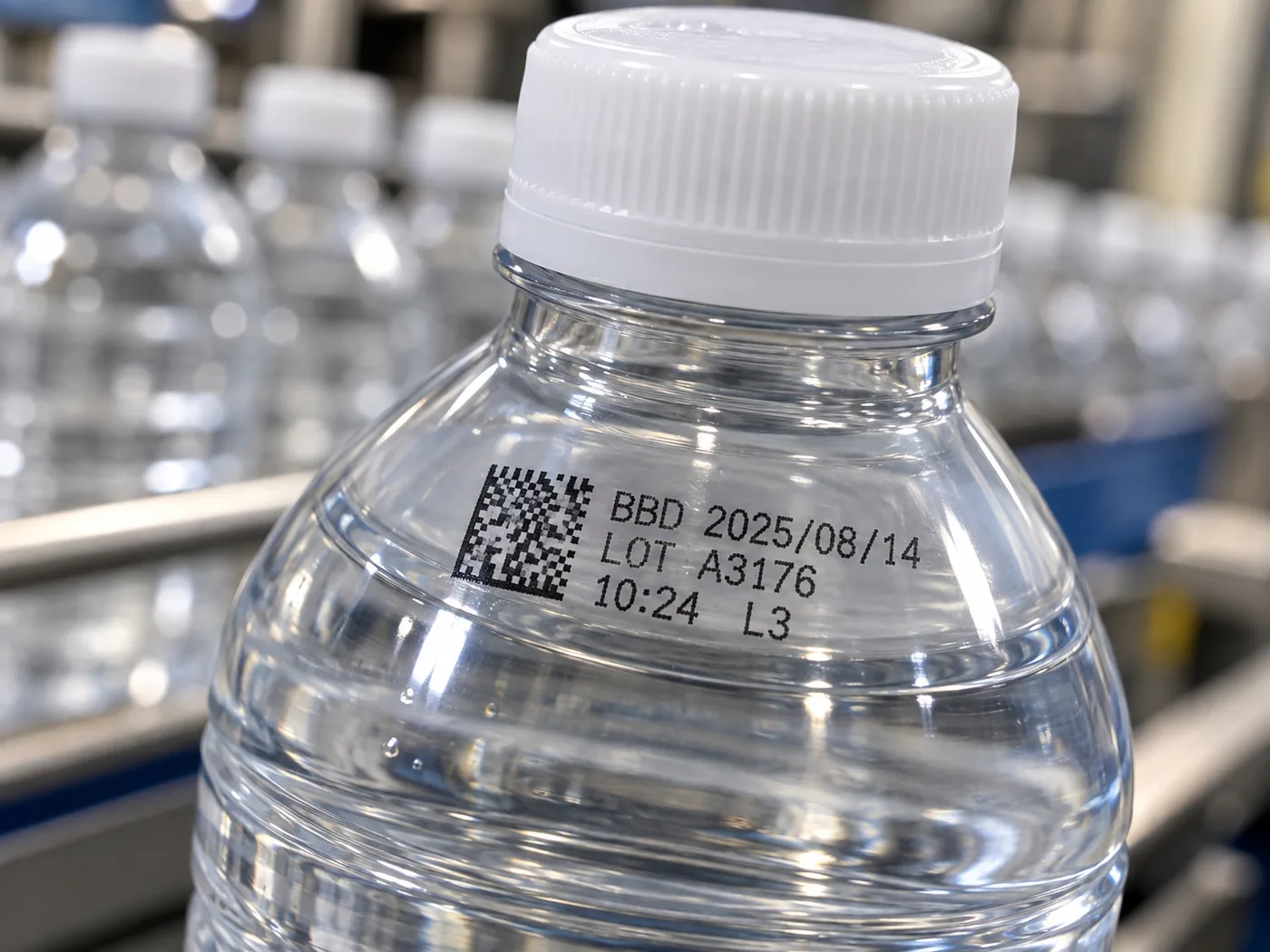
Direct inkjet coding prints variable data — dates, lot numbers, barcodes, product names and logos — straight onto the bottle, pouch, carton or case as it moves down the line. There is no label stock, no liner and no adhesive. The only thing added to the package is a thin layer of ink.
For manufacturers working to reduce packaging under EPR, that creates several advantages:
- Fewer components per pack. Removing a secondary label removes a material line from your packaging specification and, potentially, from your EPR report.
- No liner waste. Cartridge and bulk-ink printers produce no backing paper to landfill.
- Generic packaging, printed on demand. Plain or lightly branded cartons and cases can be coded with SKU-specific details at the line, so one box can serve many products. That cuts packaging inventory and the risk of obsolete stock.
- Lower running costs. Ink per print is typically a fraction of the cost of a label, and there are no applicator parts to wear out or jam.
- Faster changeovers. Switching products means selecting a new message on a touchscreen, not changing label rolls.
As always, test any change on your actual packaging. Confirm code quality, durability and scanner readability, and check with your compliance team how a design change will be reported in each state.
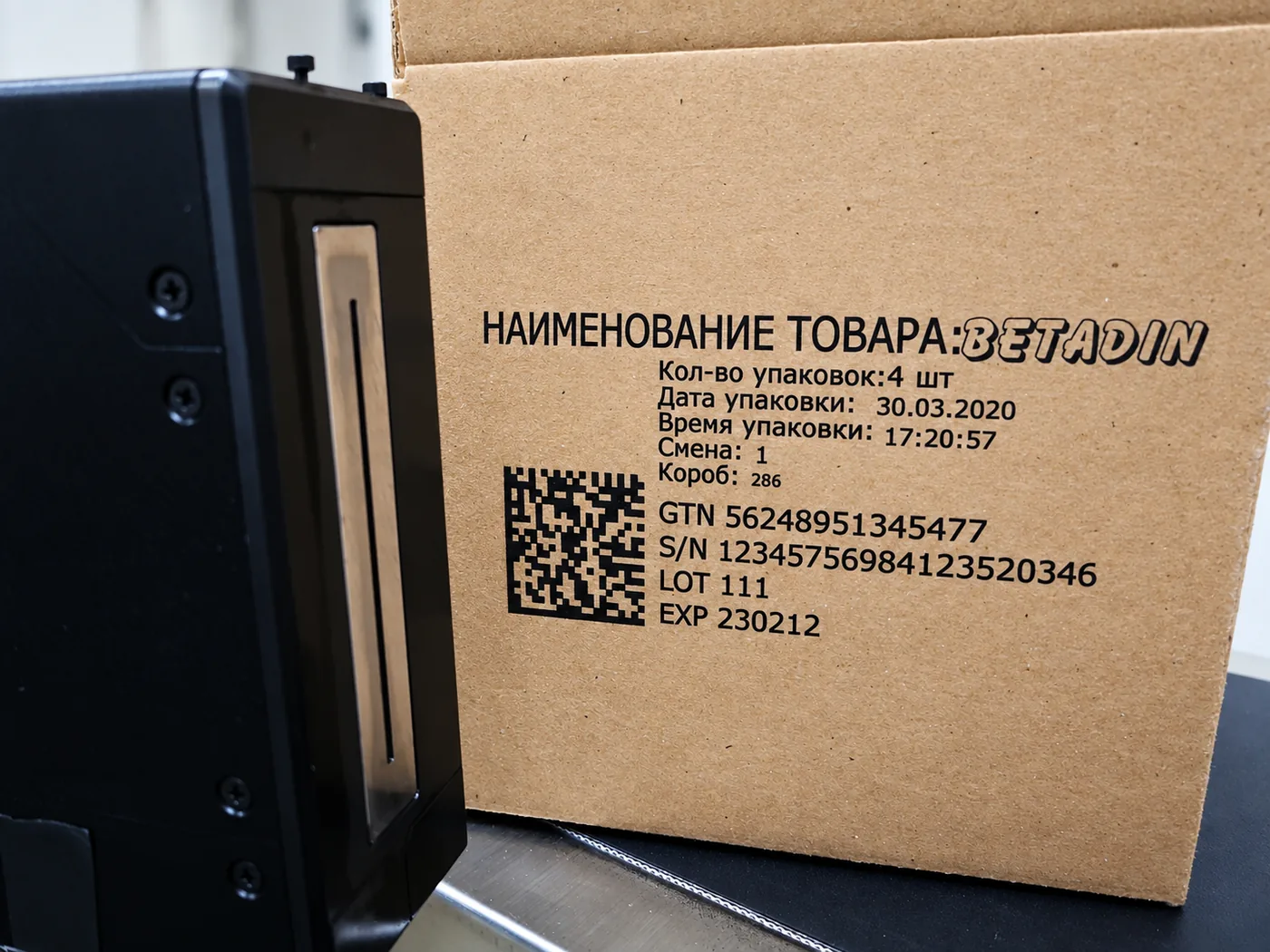
A generic, unprinted case gets all its SKU-specific data — product name, GTIN, serial, lot, expiry — printed on demand at the line, instead of being pre-printed or labeled.
Where Manufacturers Are Making the Switch
The biggest opportunities usually sit in three places on the line.
1. Primary packaging codes
Expiry dates, lot codes and batch numbers are often applied with a small sticker or a separate label on bottles, jars, pouches and cartons. High-resolution thermal inkjet (TIJ) and piezo drop-on-demand printers can print this information directly onto glass, plastic, metal, film and coated board.
2. Case and carton labels
Many plants still print a shipping label and apply it to every corrugated case. Large-character inkjet printers can print product descriptions, lot codes, barcodes and logos directly on the case, at heights up to several inches, eliminating the label altogether.
3. Pre-printed boxes
Instead of stocking dozens of pre-printed box designs, manufacturers can standardize on fewer generic cases and add the SKU details at the end of the line.
Even where a business-to-business shipping case is excluded from a state's EPR program, the case for direct printing still stands: lower material spend, less waste and less inventory.
What to Look For in an Industrial Inkjet Printer for Label Replacement
If you are evaluating direct coding to reduce labels and packaging waste, these features matter most:
- Print quality high enough for crisp text, logos and scannable barcodes.
- The right print height for each job, from small characters on primary packs to large characters on cases.
- Ink choices for your substrate, including fast-dry solvent inks for non-porous surfaces, water-based inks for corrugated, and pigmented colors such as white for dark materials.
- Low or zero maintenance, so the printer does not become a new burden for a short-staffed team.
- Simple operation, with a touchscreen, stored messages and no PC required.
- Easy integration with existing conveyors and product sensors.
- Total cost of ownership, including ink, parts and downtime, compared directly with your current label spend.
- Local support, so you get help in your time zone when you need it.
How RNJet Helps US Manufacturers Print More and Package Less
RNJet, the industrial printer brand distributed in the US by RNJet USA LLC, has designed and manufactured inkjet coding systems since 2002. Our printers are built around a simple idea: put the information directly on the product, and keep it affordable and easy to run.
For primary packaging: RNJet T Series and H Series thermal inkjet printers print dates, lot numbers, barcodes and text on bottles, pouches, cans, cartons and more. They are maintenance-free by design and a practical alternative to both labels and traditional CIJ coders.
For plastic, metal and other demanding surfaces: The RNJet 100 and RNJet 200 families print text, logos, counters, barcodes and database fields on porous and non-porous materials, with up to 18 mm character height on the RNJet 100. Bulk-ink (100+ and 200+) and large-cartridge XL models extend run times on busy lines.
For cases and cartons: Large-character printers such as the RNJet 72 XL, RNJet 140 XL and E1-140+ print directly on corrugated boxes at heights up to several inches, replacing shipping labels and many pre-printed box designs.
Why manufacturers choose RNJet:
- Plug-and-play setup with a touchscreen interface most operators learn in under 30 minutes, and no external PC needed.
- Over 1,000 stored messages on models such as the RNJet 100, so changeovers take seconds.
- An open ink system with a wide choice of colors and formulations, including pigmented white and yellow, to keep running costs down.
- Maintenance-free TIJ options that free up operator time.
- Competitive pricing that makes it realistic to convert several lines, not just one.
- North American engineering and support, backed by a distributor network.
Frequently Asked Questions
Which US states have packaging EPR laws?
As of 2026, seven states have passed packaging Extended Producer Responsibility (EPR) laws: Maine, Oregon, Colorado, California, Minnesota, Maryland and Washington. Timelines vary — Oregon and Colorado are already active, while California, Washington, Maryland and Minnesota phase in between 2027 and 2029.
Do labels count toward packaging EPR fees?
Labels are generally treated as packaging components and reported by material type and weight, the same as bottles, cartons and films. Specific rules and exemptions vary by state, so confirm the details with your Producer Responsibility Organization (PRO).
Can an industrial inkjet printer replace a label applicator?
In many applications, yes. Industrial inkjet printers can print dates, lot codes, barcodes, text and logos directly onto products and cases, removing the need for a separate pressure-sensitive label in that application.
Is direct inkjet printing more sustainable than labeling?
Direct inkjet coding typically uses far less material per unit than a label — just a thin layer of ink, no face stock, adhesive or liner — and produces no liner waste, while supporting generic packaging that reduces obsolete inventory. The exact benefit depends on your packaging and ink choice.
Does inkjet printing work on corrugated cases?
Yes. Large-character inkjet printers are designed for case and carton coding, often using water-based or fast-dry inks suited to corrugated and other porous surfaces, printing directly on the box instead of a separate shipping label.
The Bottom Line
Packaging EPR turns every gram of packaging into a cost that shows up year after year. Labels, liners and pre-printed boxes are some of the easiest places to start cutting, because the information they carry can often be printed directly on the package.
The manufacturers who move first will not only lower material and waste costs. They will also build simpler, more flexible lines that are better prepared for whatever the next state, or the next retailer requirement, brings.
Want to see what direct coding looks like on your packaging? Send us your samples for a free test print, or talk to an RNJet coding and marking specialist about replacing labels on your line.