By Dylan. Originally published by RN MARK on .
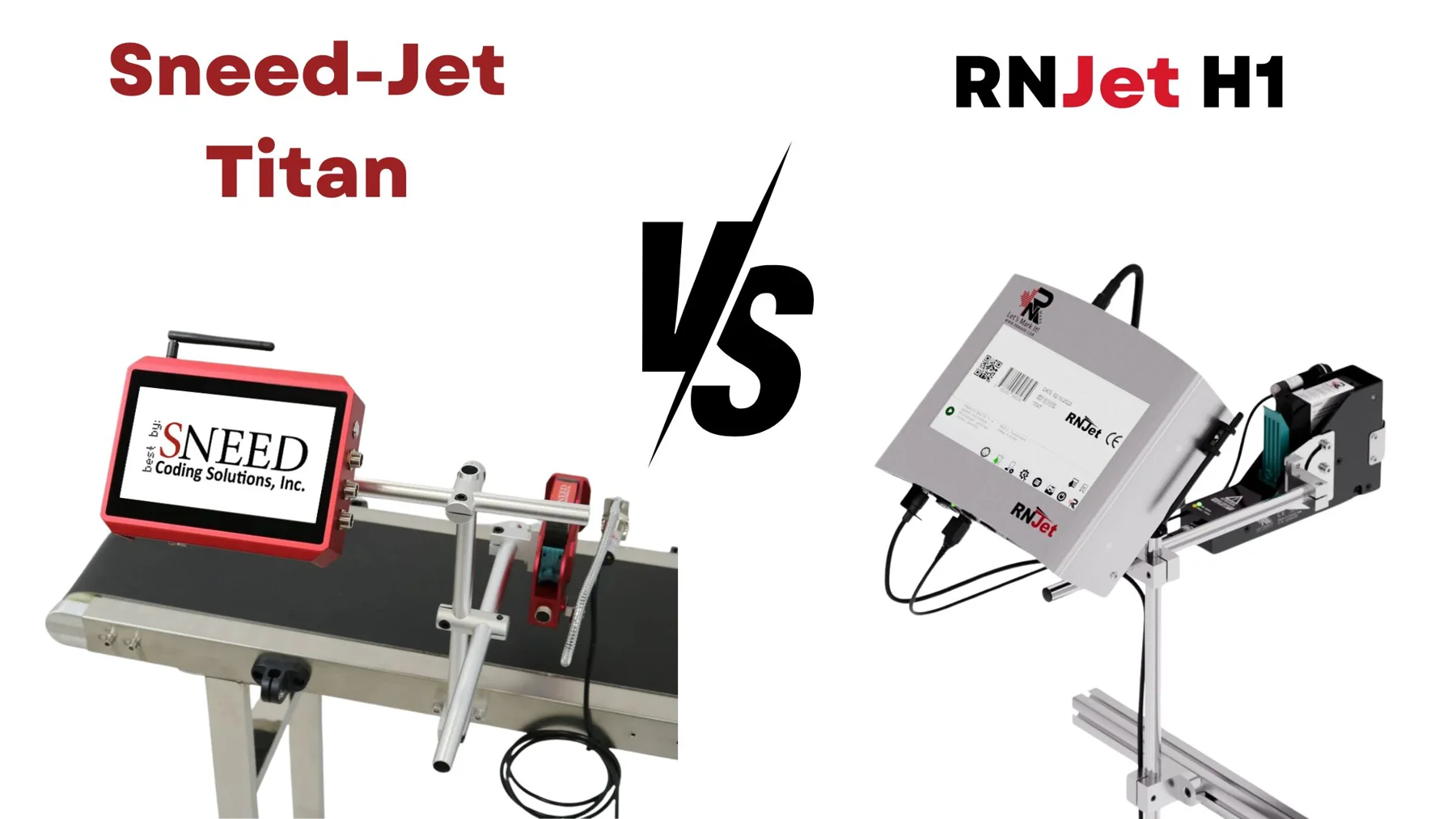
When selecting an industrial coding and marking system, reliability, integration capability, and total cost of ownership matter far more than flashy features. Two systems often compared by production teams are the SNEED-JET® Titan printers and the RNJet H1 thermal inkjet printer from RNMark. While both systems offer compact thermal inkjet (TIJ) solutions, their design philosophies and real-world suitability differ significantly.
Compare the standard half-inch Titan and the RNJet H1 on your packaging. Confirm the cartridge, line speed and installed print position for the configuration being quoted.
| Specification | RNJet H1 | SNEED-JET Titan |
|---|---|---|
| Print technology | Cartridge-based thermal inkjet | Cartridge-based thermal inkjet |
| Maximum print height | 12.7 mm | 12.7 mm for the standard Titan |
| Published print speed | Up to 180 m/min at 150 dpi or 90 m/min at 300 dpi | Up to 70 m/min on the standard Titan product page |
Sources: RNJet H1 U.S. specifications and Sneed Coding Solutions’ standard Titan specifications. For both systems, confirm the resolution, ink and message used for a quoted speed. Ask each supplier for cartridge care and startup procedures.
Compare the actual code at line speed on the same container or carton. Measure drying time, check the code after handling, and record cartridge use and operator time for each trial.
Compare U.S. batch coder configurations or discuss your sample with RNJet USA.