
Originally published by RNJet on .
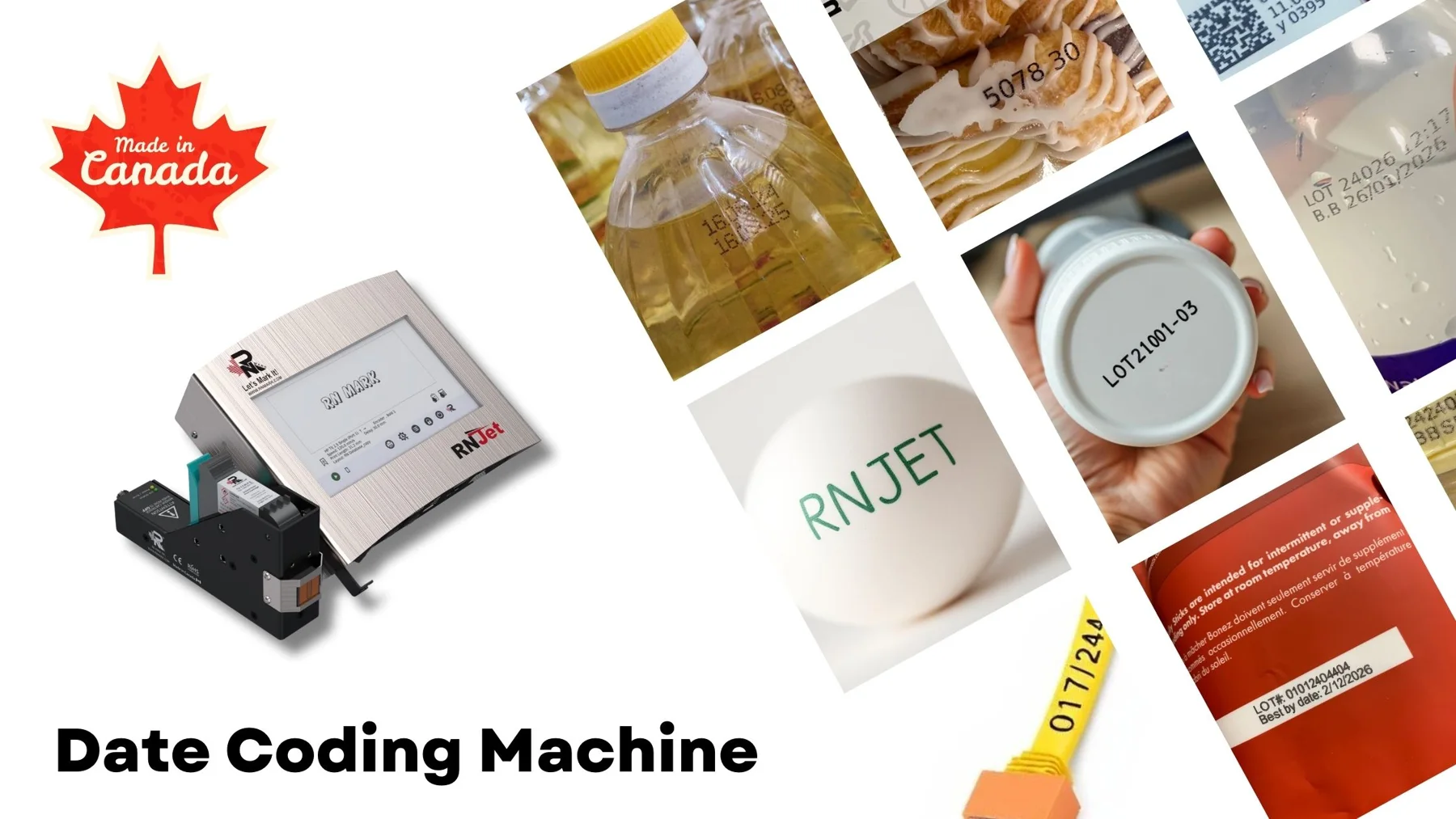
When selecting a date coding machine, understanding the key differences between TIJ (Thermal Inkjet) and CIJ (Continuous Inkjet) technologies is crucial. Both offer unique benefits and cater to different industrial needs. Below is a brief comparison:
| Feature | TIJ (Thermal Inkjet) | CIJ (Continuous Inkjet) |
| Print Method | Uses heat to create a bubble that forces ink through a nozzle. | Continuously pumps ink and directs droplets with an electric charge. |
| Print Quality | High resolution, ideal for small to medium-sized text and graphics. | Suitable for larger text and codes, but not as fine as TIJ. |
| Maintenance | Minimal maintenance easy cartridge replacement. | Requires more maintenance due to system complexity. |
| Ink Types | Primarily water-based inks for non- porous materials | Uses a variety of inks (solvent, oil-based, UV) for both porous and non-porous materials. |
| Speed | Medium-speed production lines. | High-speed production lines, capable of continuous printing. |
| Cost | Lower initial investment and operating costs. | Higher initial investment and maintenance costs but lower cost per print at high volumes. |
| Best For | Smaller production runs, low maintenance high-quality prints. | High-speed, high-volume production lines, versatile substrate compatibility. |
On this page
RNJet H1 TIJ Date Coder – Advantages Over CIJ Printers
| Feature | Details |
| Print Technology | Thermal Inkjet (TI) with HP TIJ 2.5 printhead |
| Print Speed | Up to 180 meters per minute at 150 dpi, 90 meters per minute at 300 dpi |
| Print Height | Maximum print height of 12.7 mm (0.5 inches) |
| Print Length | Maximum print length of 5500 mm |
| Print Resolution | 300 dpi for clear and sharp prints |
| Ink Compatibility | Compatible with solvent and water-based inks |
| Drying Time | Inks dry within 1-3 seconds on non-porous materials |
| Connectivity | USB, Ethernet, and RS-232 ports for easy integration |
| User Interface | 7-inch touchscreen controller housed in a durable stainless steel case |
| Operating Conditions | Temperature range: 0°C to 45°C; Humidity: 20% to 80% |
| Size (W x D x H) | 360 mm x 320 mm x 200 mm (14.17) X 12.6″ X 7.87″) |
| Weight | 7.5 kg (16.5 lbs) |
-
Cartridge care
The RNJet H1 uses replaceable ink cartridges. Follow the model instructions for cleaning and storage, and check startup print quality after an idle period. -
Compare operating costs
Use the same date and lot message for each print trial. Compare measured ink use, routine cleaning and startup time before estimating cost per package. -
User-Friendly Design
The intuitive touchscreen interface allows for easy operation, ensuring minimal training is required for operators. This ease of use helps increase productivity, reducing human error and downtime. -
Environmental Considerations
The RNJet H1’s fast-drying ink minimizes ink waste and the risk of smudging. Additionally, the use of solvent and water-based inks allows businesses to meet environmental standards while ensuring high-quality, legible prints across a range of substrates. -
Canadian Engineering Excellence
Manufactured in Canada, the RNJet H1 reflects a commitment to quality and innovation. The printer is designed and assembled in Ontario, ensuring rigorous manufacturing standards and offering support for local industry.
Applications of RNJet H1
The RNJet H1 is versatile, making it ideal for a variety of industries, including:
-
Automotive Parts: Marking components with part numbers and manufacturing dates.
-
Beverage Industry: compare RNJet USA batch and date coders and batch codes on cans and bottles.
-
Pharmaceuticals: Applying lot numbers and expiration dates on packaging.
-
Food Processing: Labeling products with production dates and ingredient information.
-
Cosmetics: Coding packaging with manufacturing details and batch numbers.
-
Electronics: Marking components with serial numbers and manufacturing dates.
Its adaptability makes it a preferred choice for industries requiring reliable and efficient date coding solutions.
Watch the original embedded media
Conclusion
Test the full date and lot code on the actual packaging at your operating speed. Check that the complete message remains readable after normal handling.